

The Business Situation
The client was operating in a competitive lead-generation market where prospects need repeated, relevant messages before they are ready to enquire. The account had delivery potential, but needed a clearer system for connecting Facebook and Instagram activity with a steady flow of measurable Meta leads.
Budget was spread across multiple campaigns and audiences, while lead intent varied significantly. Scaling without a more controlled structure risked spending more on attention that did not translate into qualified enquiries or a sustainable cost per lead.
Our priority was to create a reliable acquisition foundation: accurate lead tracking, clearer campaign roles, audience learning, compelling creative, and a low-friction path from ad engagement to form submission.
Build a reliable Meta acquisition foundation.
Better tracking, clearer campaign roles, stronger creative learning and a smoother path from engagement to enquiry.
Key Problems Identified
Campaign Structure
Campaigns needed clearer separation by prospecting, retargeting, offer and audience temperature.
Budget Efficiency
Budget was reaching people who did not consistently progress to a lead submission.
Lead Tracking
Lead tracking and reporting needed validation so optimisation decisions could be trusted.
Creative Performance
Creative needed clearer value propositions, stronger hooks and messages built for mobile attention.
Performance Framework
There was no consistent framework for comparing audiences, placements and creative performance.
Controlled Scaling
The account needed controlled scaling rather than broad increases across every ad set.
Our Growth Process
A structured approach connecting campaign data, audience behaviour, creative performance and real lead outcomes.
Performance Audit and Tracking Review
We began by auditing the Meta Ads account, lead events, campaign objectives, audiences, placements, creative, forms, and landing-page journey. The objective was to identify unclear performance data and spending that was not producing enough valuable lead activity.
This helped us separate real growth opportunities from surface-level traffic numbers. Instead of looking only at clicks or impressions, we focused on leads, cost per lead, lead quality, frequency, and scale.
Campaign and Audience Structure Rebuild
We rebuilt the account across clear prospecting, retargeting, and testing layers so every campaign had a defined role. Broad and interest-based audiences were managed alongside warm-engagement groups, while budget was directed towards the combinations creating efficient lead volume.
This structure made it easier to control budgets, compare performance, and understand which parts of the account were actually contributing to leads.
Creative and Message Testing
We tested creative angles, opening hooks, formats, calls to action, and proof points to identify the messages that encouraged prospects to stop, engage, and submit an enquiry. Winning concepts were refined while fatigued or weak creative was replaced.
This improved budget efficiency because spend was redirected toward messages and audiences more likely to produce leads at a sustainable cost.
Lead Form and Conversion Journey Optimisation
Paid social works best when the conversion experience makes responding easy. We reviewed lead-form flow, landing-page clarity, trust signals, mobile usability, and calls to action to remove friction between the ad and the enquiry.
The focus was to make it easy for prospects to understand the offer, trust the business, and submit their details without unnecessary steps or confusion.
Budget Scaling With CPL Control
Once the account showed stable lead patterns, we scaled budgets gradually. We did not scale every campaign equally. Budget increases were based on lead volume, cost per lead, audience quality, creative resilience, and frequency.
This helped the client grow lead volume while maintaining control over efficiency and reducing the risk of overspending on weak audiences or fatigued creative.
Execution Focus
The project was handled as a complete performance system rather than a simple ad campaign setup. We connected campaign decisions with audience behaviour, creative performance, and real lead outcomes.
Every optimisation was reviewed through a commercial lens: whether it helped reduce wasted spend, improve lead quality, lower cost per lead, or make scale more predictable.
What Changed for the Client
Better clarity on which campaigns, audiences, and creatives were driving leads.
Budget allocation became more strategic instead of being spread too broadly.
The lead journey became more aligned with paid-social behaviour and mobile expectations.
Campaign performance became easier to measure, manage, and improve over time.
The business gained a stronger foundation for future scaling across paid channels.
From fragmented ad activity to a scalable Meta lead-generation system.
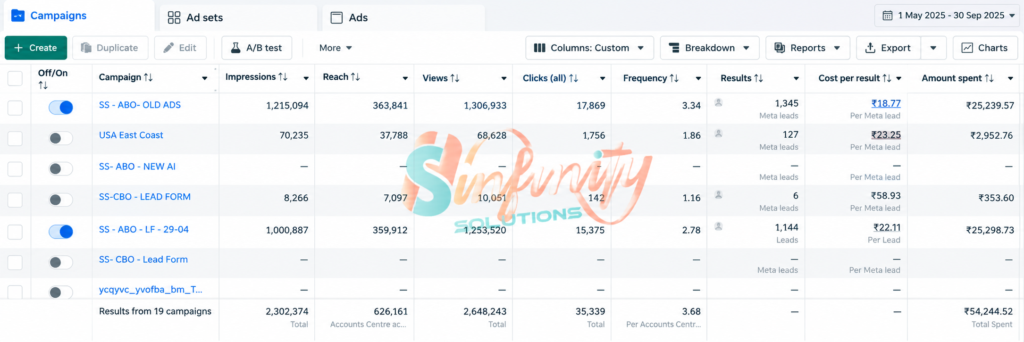
Across the reporting period, the campaign delivered 2.30M impressions, reached 626K people, and generated 2.62K Meta leads from £54.24K in spend — at an average cost per lead of £20.69.
More importantly, the client gained a clearer system for understanding performance and making smarter growth decisions.
The work created a stronger paid-acquisition foundation: better lead tracking, tighter budget control, stronger creative learning, and a scalable approach to increasing lead volume without relying on guesswork.
Ready to build a growth system like this?
Let’s turn your paid campaigns into a measurable, scalable acquisition channel.
Get Similar Results →